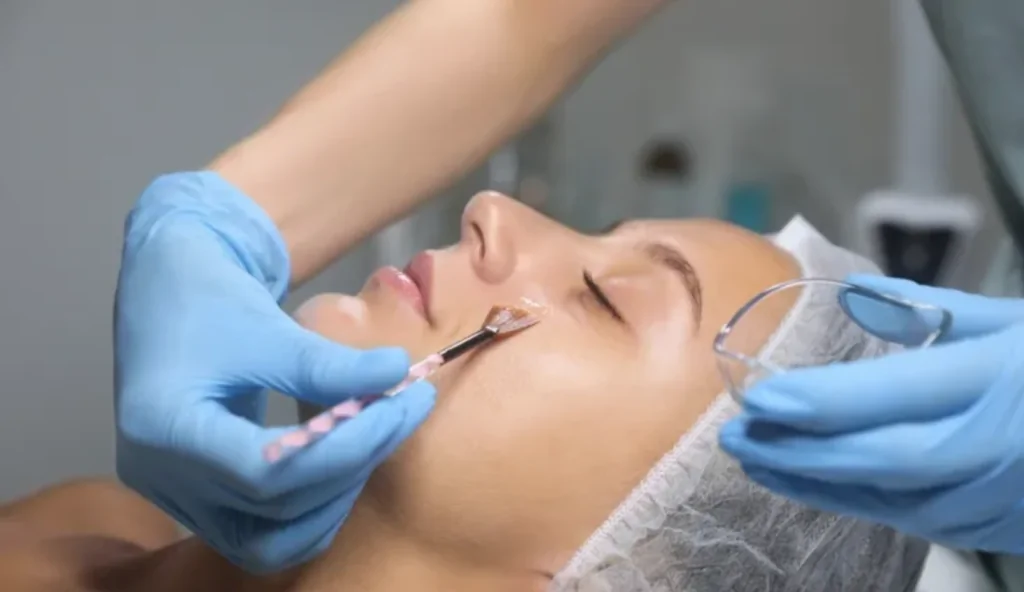
Creating a customized skin care routine that targets your individual concerns and skin type is vital so that you can maintain a healthy complexion. But if you have attempted to adapt your skincare routine to your particular skin type and still are not seeing the results you want, it might be time to consider adding a professional chemical peel to your arsenal.
Unlike the weekly at-home self-scrub you may be performing, a professional peel is an in-office, acid-based resurfacing treatment that exfoliates your skin on a deeper level. This results in a younger-looking, healthy complexion. The skincare professionals at DeSilva Dermatology will apply a chemical solution to your skin’s surface to remove the dead skin cells and stimulate cell regrowth.
Professional peels address various skin concerns such as fine lines, wrinkles, hyper-pigmentation, acne, and mild scarring. They also improve skin texture and stimulate collagen production.
There are three types of professional peels
These categories define how many layers of skin the peel affects.
A light peel is a good way to begin if you’ve never had a professional peel before. They are referred to as “lunchtime peels,” since their relatively mild peeling agents only address the epidermis (the top layer of your skin). You may want to have a light peel once every month.
Medium-depth professional peels involve both the epidermis and dermis underneath. If you’ve been getting light peels and the results are less than desirable, it may be time to take it to the next stage. You may want to get a medium peel every four to six weeks.
The strongest peels available penetrate deep into the layers of the dermis. While they require more recovery time than light and medium-depth peels, they’re the best option for achieving long-lasting, noticeable results with just one treatment. People may get deep peels once in a lifetime or under a professional’s evaluation (often every 10 years or so).
A professional peel is similar to other types of treatments. After pulling back your hair, your DeSilva professional will clean your face with a saturated cotton ball, sponge, brush, or gauze. You may experience a tingling or stinging sensation for 15 to 20 minutes.
Next, a neutralizing solution will be followed by a hydrating, restoring, and protecting cream. You may experience redness, irritation, and peeling for approximately four to seven days after a medium peel and seven to 21 days after a deep peel.
Do not get a peel right before a special event, because you will experience some downtime. Avoid scheduling a professional peel before a special event, especially if it’s medium or deep.
Three days after your peel, you may notice mild to moderate peeling. This is common, allowing new, healthy skin to come to the surface. Don’t pick at your skin during this process, as this can cause hyperpigmentation.
Don’t put makeup, ice or hot or cold water on your skin. Instead, ask about purchasing a post-procedure kit from your DeSilva specialist.
Wait at least 10 days before using any Retinol or Glycolic Acid products, and five days for acne treatments like Tretinoin, including Renova and Retin-A.
Don’t exfoliate your face with a washcloth or scrub for at least seven to 10 days. Avoid activities that increase your body temperature for the first 48 hours. This includes:
Want to accelerate your skincare results? Find out if a PCA peel is right for you! Contact DeSilva Dermatology for a consultation.




120 Old San Antonio Rd
Boerne, TX 78006
Find us on Google Maps